Start with the part that costs nothing: your hands do most of this already. Every technique on this site works with fingers alone, and if you’ve never tried facial massage, that’s where to begin rather than with a purchase.
What follows is for people who’ve done that and want to know what a tool adds. Sometimes the answer is quite a lot. Sometimes it’s nothing at all.
Gua sha stones
What it adds: an edge that hooks under the jawbone, and a surface that stays cool. Neither is available from fingers.
Material matters less than shape. Jade, rose quartz, bian stone and stainless steel all get marketed with different properties, and the differences in practice are small. Rose quartz stays cooler slightly longer. Steel stays cooler longest and is the only one that won’t shatter on a tiled floor. Jade warms fastest. Claims beyond temperature belong to crystal marketing rather than to anything measurable.
Shape is what you’re actually choosing. The classic heart shape has three usable parts: a long gentle curve for cheeks, a deeper notch that fits over the jawbone, and a point for small areas around the brow. A flat rectangle handles the neck well and the jaw poorly. Comb-edged stones are for the scalp and don’t do anything the classic shape can’t.
What to look for: smooth edges with no seams or roughness you can feel with a fingernail. Run the edge along your inner forearm before using it on your face. Anything that catches there will catch on skin.
Price: somewhere between £8 and £20 covers everything that matters. Above that you’re paying for packaging, branding, or claims about the crystal. A £60 stone doesn’t move fluid better than a £12 one.
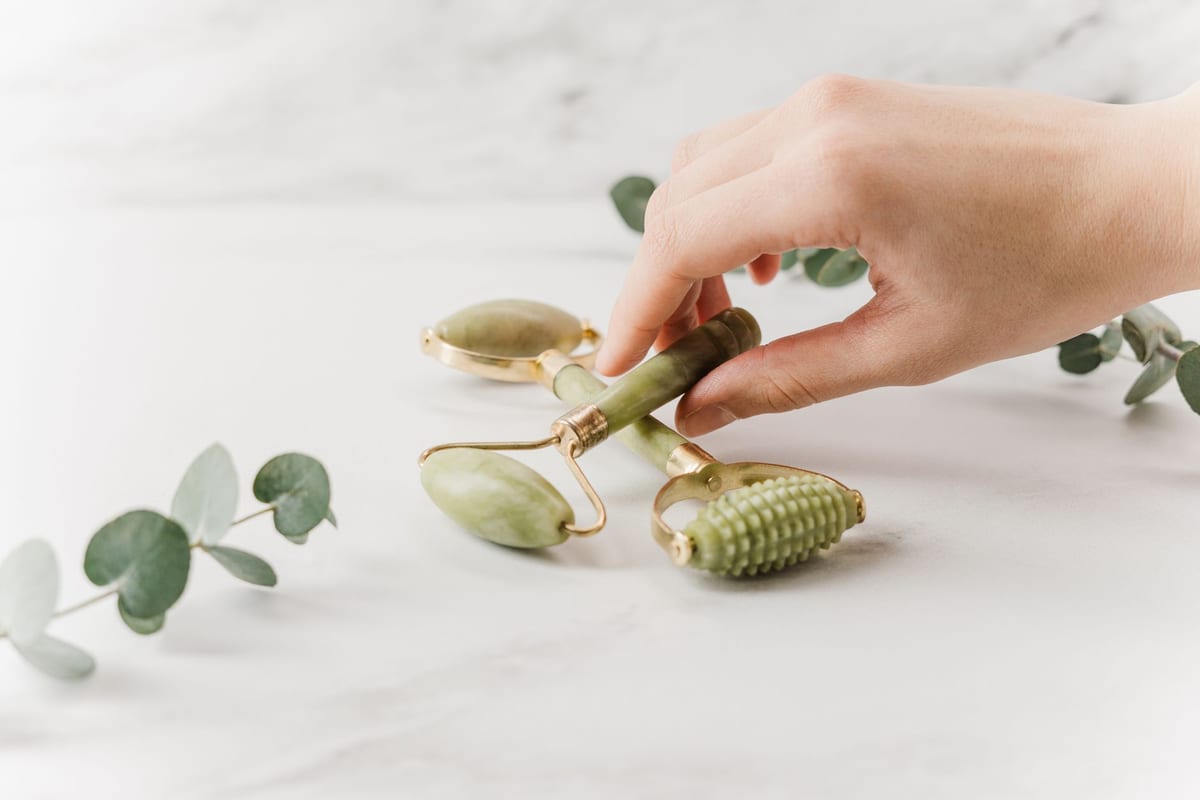
Facial rollers
What it adds: cooling over a broad area, quickly, with almost no technique required.
Rollers are genuinely good at one thing: puffy under-eyes on a bad morning. Cold constricts blood vessels, the rolling motion is gentle, and it’s hard to do wrong. If mornings are your problem and you want something requiring no skill at all, this is the tool.
What it doesn’t do well: anything that needs a defined edge. Rollers can’t hook under the jaw, can’t apply held pressure to the masseter, and can’t work small areas precisely. They spread pressure rather than direct it.
A common annoyance: cheap rollers develop a squeak, and the metal frames loosen. If the stone wobbles in its cradle when you press, it’ll get worse.
Price: £10 to £25. Keeping it in the fridge doubles its usefulness and costs nothing.
Microcurrent devices
This is a different category, and worth being clear about the difference.
Stones and rollers move fluid. Microcurrent sends a low-level electrical current through facial muscles, causing them to contract. It’s muscle work rather than drainage, which is why it belongs in the same conversation as face yoga rather than the same conversation as gua sha.
What the evidence says: there’s more research here than for gua sha, mostly on muscle stimulation generally rather than facial ageing specifically. Effects are cumulative and require regular use, typically five sessions a week initially. Stop using it and effects fade over weeks.
What that means practically: it’s a commitment, not a purchase. A device used twice and left in a drawer does nothing, and this is the most commonly abandoned category in the whole home-device market.
Price: £150 to £400 for established brands, with cheaper unbranded units widely available. The gap between them is real: conductivity, current control and build quality all differ, and cheap units frequently deliver less current than claimed.
Who it suits: people already doing something daily for their face who want to add a step. Not people hoping a device will create a habit they don’t have.
What to skip
Vibrating wands. The vibration doesn’t add anything the movement wasn’t already doing. Battery, motor, noise, no mechanism.
Anything promising to “lift” or “sculpt” permanently. No handheld device changes bone or repositions tissue. That vocabulary is a reliable signal that the marketing has run ahead of the product.
Multi-tool kits with six pieces. You’ll use one. The rest occupy a drawer. Buy the one shape you’ll actually reach for.
Heated stones. Heat feels pleasant and works against you here: it dilates vessels, which is the opposite of what reduces puffiness.
If you’re buying one thing
A basic gua sha stone in a classic shape. It handles every technique on this site, costs less than a takeaway, and doesn’t need batteries or replacing.
Add a roller later if morning puffiness is your main complaint. Consider microcurrent only after several months of consistent routine, when you know you’ll actually use it.
The honest summary
Tools make some things easier and one or two things possible. They don’t make the difference between working and not working. A stone used twice a month does less than fingers used every morning.
Anyone telling you otherwise is selling the stone.
This page doesn’t currently contain affiliate links. When we join the relevant programs, links will be added and marked clearly, and this note will be replaced by a full disclosure.