
Face yoga sits in an odd position. There’s one decent study behind it, an enormous amount of hopeful content built on top of that study, and very little in between.
Here’s what the exercises look like, what the evidence supports, and where the limits sit.
What the research says
The study everyone cites came out of Northwestern University in 2018. Sixteen women aged 40 to 65 did 30 minutes of facial exercises daily for eight weeks, then every other day for another twelve.
Dermatologists rated their photographs before and after. Average estimated age dropped by roughly three years, and cheek fullness improved measurably.
That’s a real result and worth taking seriously. It’s also a small study with no control group, an unblinded design, and a schedule almost nobody sustains. Twenty weeks of daily half-hour sessions is a serious commitment.
So the fair summary: some evidence, small sample, requiring effort most people won’t put in. That’s a narrower claim than “face yoga works”, and a considerably more useful one.
The muscles you’re working
Your face has over forty muscles, and unlike the ones in your arms, many attach directly to skin rather than bone. That’s the mechanism this whole idea rests on. Strengthen the muscle and the skin sitting on top of it may sit differently.
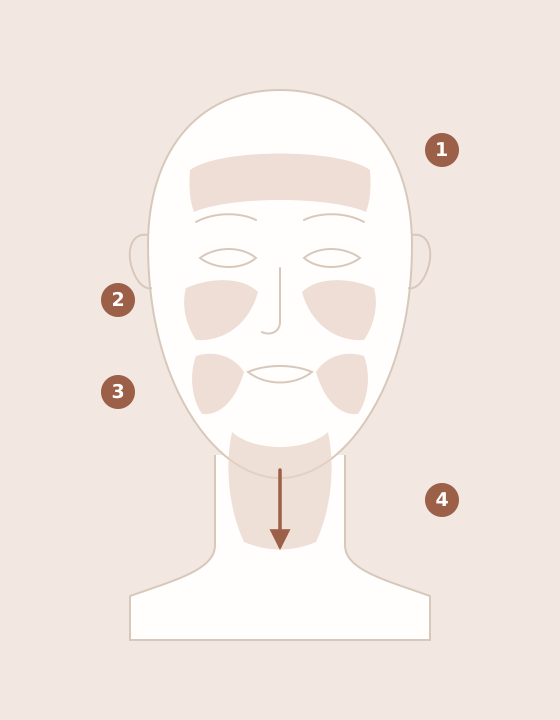
Three of them matter for the lower face. The masseter closes the jaw and thickens in people who clench. The platysma is a broad thin sheet running from the collarbone up over the jaw, and it’s what most neck exercises target. The zygomaticus muscles lift the corners of the mouth.
The sequence
Five exercises, ten minutes. Use a mirror the first few times, because several of these are easy to do wrong in a way you won’t feel.
1. Jaw release. Open your mouth slowly as wide as is comfortable, hold three seconds, close slowly. Ten times. This warms up rather than works, and skipping it makes everything after it feel stiff.
2. Resistance hold. Put your fist under your chin. Try to open your jaw while your fist stops it. Hold ten seconds, rest, five rounds. You should feel this under the chin, not in your teeth.
3. Tongue press. Press the flat of your tongue hard against the roof of your mouth and hold twenty seconds. Three rounds. This works the floor of the mouth, the layer sitting under a soft chin.
4. Neck extension. Tilt your head back slightly, shoulders down. Push your lower lip out over the upper one. You’ll feel a pull down the front of the neck. Hold five seconds, ten times.
5. Full release. Let your jaw hang completely slack for thirty seconds. Breathe. Most people carry tension here without noticing, and finishing on release matters more than it sounds.
The mirror problem
Almost nobody mentions this, and it’s why plenty of people get no result at all.
Facial exercises are unusually easy to do incorrectly. You can’t see what you’re doing, and feedback from facial muscles is vague compared with, say, a bicep. People routinely believe they’re working the platysma while actually clenching the masseter, which is the opposite of helpful if you already grind your teeth.
Watch yourself in a mirror for the first week. If your jaw muscles bulge during a neck exercise, you’re recruiting the wrong thing.
About those before-and-after photos
You’ll find thousands of them, and as evidence they’re worth close to nothing.
Lighting, camera angle, head position and time of day change how a face looks more than eight weeks of exercise does. A photo taken slightly from above with the chin pushed forward will always show a better jawline than one taken from below. That’s geometry, not muscle.
This isn’t necessarily deliberate deception. People genuinely believe what they’re seeing. It does mean the visual evidence circulating online tells you nothing reliable, which is why you won’t find that kind of photo on this site.
What it doesn’t do
It doesn’t remove fat. Working a muscle under a layer of fat doesn’t reduce the layer. If the softness under your chin is fat, these exercises change the muscle beneath it and leave the fat exactly where it was.
It doesn’t tighten loose skin. Laxity comes from collagen and elastin changes within the skin itself. Strengthening the muscle underneath restores neither.
It can make jaw tension worse. If you clench at night, adding daily masseter work may add to the problem. In that case do the release exercises and skip the resistance holds.
It isn’t fast. The study ran twenty weeks. Anything promising visible change in two is describing something that came from somewhere else.
Who this actually suits
People who’ll do it consistently for months, with realistic expectations, whose main complaint is muscle tone rather than fat or loose skin.
That’s a narrower group than the volume of content on this topic suggests. If you’re in it, ten minutes a day has some genuine evidence behind it. If you’re not, no amount of daily effort will change that, and it’s better to know now than after twenty weeks.